Gledius: A Modern Blackletter Font for Handmade Brands
If you’ve ever struggled to find a blackletter font that feels both timeless and shop-ready—bold enough for signage but clean enough for delicate labels—you’ll understand why Gledius has become my go-to display font for physical products. As someone who designs printable wedding suites, hand-stamped tags, Cricut-cut wall art, and small-batch product packaging, I need fonts that cut cleanly, print crisply, and carry weight without sacrificing legibility. Gledius delivers exactly that: a contemporary blackletter typeface rooted in Gothic tradition but refined for today’s handmade marketplace.
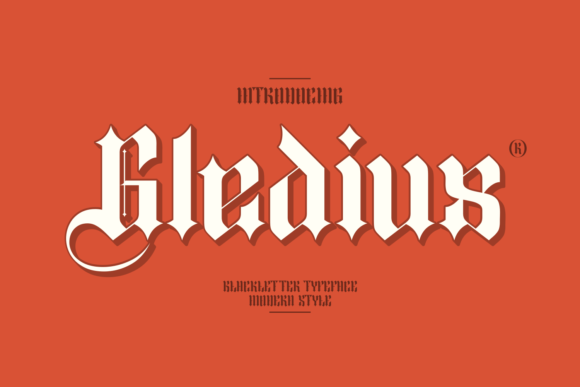
Visually, Gledius balances sharp serifs and confident strokes with subtle openness in the counters and generous spacing—details that make all the difference when scaling down for 0.5-inch sticker labels or scaling up for a 24×36″ farmhouse welcome board. Unlike many traditional blackletter fonts that feel dense or overly ornate, Gledius breathes. Its letterforms retain intricate character—especially in uppercase glyphs—but avoid visual clutter. The lowercase “a,” “e,” and “g” have gentle, modern articulation, while capitals command attention without intimidation. That duality is rare—and incredibly useful.
I use Gledius most often where typography needs to do double duty: convey heritage or craftsmanship *and* support clear brand messaging. Think candle jar labels for a lavender apothecary line—“Wild Sage & Cedar” in Gledius over a cream kraft label reads premium, intentional, and quietly luxurious. Or boutique clothing tags stamped on recycled cardstock: the font’s structured rhythm gives each piece cohesion, helping customers associate that distinct look with your shop across every touchpoint.
It shines in seasonal and celebratory contexts too. For fall-themed SVG designs, Gledius adds gravitas to phrases like “Gather,” “Harvest,” or “Home.” In wedding stationery, it anchors “Mr. & Mrs.” or monogrammed initials on foil-stamped invitation suites—never overwhelming the paper texture, always elevating it. And yes—it works beautifully on mugs and tote bags. Because the outlines are well-defined and stroke contrast is consistent, Gledius holds up in screen printing, heat transfer vinyl, and sublimation—no pixelation, no lost detail.
Readability matters—especially at small sizes. I test every font I use on actual cutting machines before listing a template. Gledius cuts cleanly on both Cricut and Silhouette machines at 0.25" height (with slight kerning adjustment), and remains legible on 1.25" hang tags. For printed cards, I recommend using it at 14pt minimum for body copy elements (like event times or vendor credits) and reserving smaller sizes strictly for decorative accents. Its bold weight means it doesn’t fade in offset or digital print—critical when selling printable planner pages or digital downloads meant for home printing.
Pairing Gledius thoughtfully expands its versatility. I often combine it with a relaxed handwritten font—like a natural ink script—for names or personal messages, letting Gledius handle titles and structural text. For packaging or branding systems, I pair it with a warm, humanist sans serif (think Montserrat or Poppins) for ingredient lists, care instructions, or website copy. That contrast—structured blackletter meets approachable sans—creates visual hierarchy *and* emotional balance: tradition meets trust, strength meets warmth.
Gledius includes standard OpenType features that elevate real-world use: stylistic alternates for more expressive caps, discretionary ligatures for elegant word connections (“fi,” “fl,” “ff”), and multilingual support covering Western European languages—essential if you sell internationally or design bilingual holiday cards. It’s delivered in OTF and TTF formats, so it loads reliably in Canva, Adobe Creative Cloud, Cricut Design Space, and Silhouette Studio.
One practical note: always check the commercial license. Gledius is licensed for physical product use—including labels, stickers, apparel, and signage—as well as digital downloads, templates, SVG files, and client work. That means you can embed it into editable Canva templates, include it in layered PSD mockups, or use it to design SVG bundles for Etsy—no extra fees or attribution required. Just keep a copy of the license handy for your records, especially if you’re selling design assets or white-labeling for other makers.
In my shop, Gledius has become the quiet anchor behind several best-selling collections: a vintage-inspired holiday printable set (where it headlines “Yuletide Cheer” and “Twelve Days”), a botanical soap label series (used for scent names like “Bramble & Birch”), and even a set of minimalist wedding signage SVGs—because sometimes less is more, and Gledius says *more* with restraint.
It’s not just another blackletter font. It’s a tool that helps handmade sellers communicate quality before the customer even reads a word. When your product sits next to dozens of others—on a craft fair table, an Etsy search grid, or a boutique shelf—Gledius gives your brand visual authority without shouting. It signals care, intention, and attention to detail—the very things handmade buyers seek.
If you're building a cohesive, scalable brand identity—or simply want one display font that performs across stickers, signs, packaging, and printables—Gledius earns its place in your font library. Not as a novelty, but as a working asset: reliable, expressive, and quietly distinctive.